The Art of Successful Busking for Fun and Profit

Street performance or busking is the act of performing in public places for gratuities. In many countries, the rewards are generally in the grade of money but other gratuities such every bit nutrient, potable or gifts may be given. Street performance is skillful all over the world and dates back to antiquity. People engaging in this practice are called street performers or buskers in the Great britain. Buskers is not a term by and large used in American English.[1] [ii]
Performances are anything that people find entertaining, including acrobatics, brute tricks, balloon twisting, caricatures, clowning, one-act, contortions, escapology, dance, singing, burn skills, flea circus, fortune-telling, juggling, magic, mime, living statue, musical performance, puppeteering, serpent mannerly, storytelling or reciting poetry or prose, street art such every bit sketching and painting, street theatre, sword swallowing, and ventriloquism.
Etymology [edit]
The term busking was first noted in the English effectually the eye 1860s in Great U.k.. The verb to busk, from the word busker, comes from the Castilian root word buscar, with the meaning "to seek".[3] The Spanish word buscar in turn evolved from the Indo-European word *bhudh-skō ("to win, conquer").[4] It was used for many street acts, and was the title of a famous Spanish book nigh one of them, El Buscón. Today, the give-and-take is still used in Castilian but mostly reserved for female person street sex workers, or mistresses of married men.[ citation needed ]
History [edit]


An organ grinder in Paris, photographed past Eugène Atget, c. 1898–99
There have been performances in public places for gratuities in every major culture in the world, dating back to artifact. For many musicians, street performance was the most common means of employment before the advent of recording and personal electronics.[5] Prior to that, a person had to produce whatever music or entertainment, save for a few mechanical devices such as the barrel organ, the music box, and the piano roll. Organ grinders were normally establish busking in the quondam days.
Busking is mutual among some Romani people. Romantic mention of Romani music, dancers and fortune tellers are found in all forms of song poetry, prose and lore. The Roma brought the word busking to England by way of their travels along the Mediterranean coast to Espana and the Atlantic Bounding main and and then up north to England and the rest of Europe.[ citation needed ]
In medieval France, buskers were known by the terms troubadours and jongleurs. In northern French republic, they were known every bit trouveres. In erstwhile German, buskers were known every bit Minnesingers and Spielleute. In obsolete French, it evolved to busquer for "seek, prowl" and was mostly used to depict prostitutes. In Russia, buskers are called skomorokh, and their first recorded history appears effectually the 11th century.[ citation needed ]
Mariachis, Mexican bands that play a fashion of music by the aforementioned name, frequently busk when they perform while traveling through streets and plazas, as well as in restaurants and bars.[6]
We like playing for big crowds, and the goal all along has been for people to pay a fiddling to come up and see us. But it all started on street corners, and that is still very continued to what we do. It's such a validating musical experience. Busking is a very humble and brave act that takes backbone to practise well. Information technology'due south also nearly the energy of music beingness live outside in a city ... Yous tin can walk right by it right in front end of you. Sure, to some people you're only some other guy with his hand out, so sometimes busking can be peachy social barometer. You're able to gauge who you live with on earth.[vii]
Ketch Secor, Old Crow Medicine Prove
Around the mid-19th century Japanese Chindonya started to be seen using their skills for advertising, and these street performers are even so occasionally seen in Japan. Another Japanese street operation form dating from the Edo period is Nankin Tamasudare, in which the performer creates large figures using a bamboo mat.

In the 19th century, Italian street musicians (mainly from Liguria, Emilia Romagna, Basilicata) began to roam worldwide in search of fortune. Musicians from Basilicata, especially the so-called Viggianesi, would later become professional instrumentalists in symphonic orchestras, especially in the U.s.a..[eight] The street musicians from Basilicata are sometimes cited every bit an influence on Hector Malot's Sans Famille.[9]
In the United States, medicine shows proliferated in the 19th century. They were traveling vendors selling elixirs and potions to meliorate the health. They would often apply amusement acts as a way of making the clients feel better. The people would oftentimes associate this feeling of well-beingness with the products sold. Later these performances, they would "pass the hat".[ citation needed ]
1-man bands have historically performed as buskers playing a multifariousness of instruments simultaneously. 1-human bands proliferated in urban areas in the 19th and early 20th centuries and still perform to this day. A current i-man band plays all their instruments acoustically usually combining a guitar, a harmonica, a drum and a tambourine. They may besides include singing. Many however busk simply some are booked to play at festivals and other events.[ citation needed ]
Folk music has always been an important role of the busking scene. Cafe, eating house, bar and pub busking is a mainstay of this art form. Ii of the more famous folk singers are Woody Guthrie and Joan Baez. The delta bluesmen were more often than not itinerant musicians emanating from the Mississippi Delta region of the USA around the early 1940s and on. B.B. King is ane famous example who came from these roots.[ citation needed ]

The counterculture of the hippies of the 1960s occasionally staged "be-ins", which resembled some present-24-hour interval buskers festivals. Bands and performers would gather at public places and perform for free, passing the lid to make money. The San Francisco Bay Area was at the epicenter of this movement – be-ins were staged at Gilded Gate Park and San Jose'due south Bee Stadium and other venues. Some of the bands that performed in this manner were Janis Joplin with Large Brother and the Holding Visitor, the Grateful Dead, Jefferson Airplane, Quicksilver Messenger Service, Country Joe and the Fish, Moby Grape and Jimi Hendrix.[ commendation needed ]
Christmas caroling tin can also exist a grade of busking, as wassailing included singing for alms, wassail or some other form of refreshment such as figgy pudding. In the Democracy of Ireland, the traditional Wren Boys, and in England Morris Dancing tin can be considered office of the busking tradition.[ citation needed ]
In India and Pakistan's Gujarati region, Bhavai is a form of street fine art where there are plays enacted in the village, the barot or the village vocaliser also is part of the local entertainment scene.[ commendation needed ]
In the 2000s, some performers have begun "Cyber Busking". Artists post work or performances on the Internet for people to download or "stream" and if people similar information technology they make a donation using PayPal.[ commendation needed ]
Forms [edit]
There are 3 basic forms of street performance
"Circle shows" are shows that tend to assemble a crowd around them. They commonly have a singled-out beginning and finish. Usually these are done in conjunction with street theatre, puppeteering, magicians, comedians, acrobats, jugglers and sometimes musicians. Circle shows can exist the most lucrative. Sometimes the crowds attracted tin can exist very large. A good busker will command the oversupply then the patrons do not obstruct human foot traffic.
"Walk-past acts" are typically where the busker performs a musical, living statue or other act that does not have a distinct start or end, and the public commonly watches for a brief time. A walk-by human activity may turn into a circle bear witness if the act is unusual or very popular.
"Stoplight performers" present their human activity and get contributions from vehicle occupants on a crosswalk while the traffic lights are red. A variety of disciplines can be used in such a format (juggling, intermission dancing, even magic tricks). Because of the brusque period of time available to them, stoplight performers must have a very brief, condensed routine. This course is seen more normally in Latin America than elsewhere.
Collecting money [edit]
Buskers collect donations and tips from the public in a diverseness of containers and past unlike methods depending on the type of busking they are performing. For walk-by acts, their instrument case or a special can or box is oft used. For circumvolve shows the performer will typically collect coin at the end of the bear witness, although some performers volition also collect during the bear witness to ensure all audition members have had a chance to show appreciation for their skills. Sometimes a performer will apply a bottler, hat man, or pitch human to collect money from the audience. The term bottler is a British term that originated from the use of the top half of a bottle to collect money. The bottle had a leather flap inserted in the clogging and a leather pouch attached. This design allowed coins to be put in the bottle just did not allow them to be removed hands without the coins jingling against the glass. The first use of such contrivances was recorded past the famous Dial and Judy troupe of puppeteers in early Victorian times.[10] Bottling itself can be an art course, and the difference between a good and a bad bottler can exist crucial to the amount of money earned on a pitch. A skilful bottler is able to encourage audience members to give money. A bottler normally gets a cut of the money made on the pitch. Prior to the 20th century, information technology was common for buskers to use a trained monkey as a bottler. That practice has diminished or ceased in many countries due to changes in social attitudes and animal control laws. However, some modern buskers use a device known equally monkey stick which is a long stick with canteen caps or small cymbals attached to brand a noise before a prove or prior to making a collection.
Pitches [edit]
The identify where a performance occurs is chosen a "pitch". A good pitch tin can exist the key to success as a busker. An act that might make coin at i place and time may not work at all in another setting. Popular pitches tend to exist public places with large volumes of pedestrian traffic, high visibility, low background noise and as few elements of interference as possible. Skilful locations may include tourist spots, popular parks, entertainment districts including many restaurants, cafés, bars and pubs and theaters, subways and bus stops, exterior the entrances to large concerts and sporting events, about whatever plaza or town foursquare besides every bit zócalos in Latin America and piazzas in other regions. Other places include shopping malls, strip malls, and outside supermarkets, although permission is usually required from management for these.
In her volume, Underground Harmonies: Music and Politics in the Subways of New York, Susie J. Tanenbaum examined how the aphorism "Music hath charms to soothe the brutal fauna" plays out in regards to busking. Her sociological studies showed that in areas where buskers regularly perform, crime rates tended to go down, and that those with higher pedagogy attainment tended to have a more than positive view of buskers than did those of bottom educational attainment.[11] Some cities encourage busking in particular areas,[12] giving preference to metropolis government-approved buskers and even publishing schedules of performances.[13]
Many cities in the United States have particular areas known to be popular spots for buskers. Performers are found at many locations like Mallory Square in Central W, in New Orleans, in New York around Fundamental Park, Washington Square, and the subway systems, in San Francisco, in Washington, D.C. around the transit centers, in Los Angeles around Venice Embankment, the Santa Monica Tertiary Street Promenade, and the Hollywood expanse, in Chicago on Maxwell Street, in the Delmar Loop commune of St. Louis, and many other locations throughout the US. Busking is yet quite common in Scotland, Republic of ireland, and England with musicians and other street performers of varying talent levels.
Legislation [edit]
The first recorded instances of laws affecting buskers were in ancient Rome in 462 BC. The Law of the Twelve Tables fabricated it a criminal offence to sing most or make parodies of the government or its officials in public places; the penalty was death.[14] [fifteen] Louis the Pious "excluded histriones and scurrae, which included all entertainers without noble protection, from the privilege of justice".[16] In 1530 Henry Viii ordered the licensing of minstrels and players, fortune-tellers, pardoners and fencers, also as beggars who could non piece of work. If they did not obey they could exist whipped on two sequent days.[17]
In the U.s. under constitutional law and nigh European common law, the protection of creative free oral communication extends to busking. In the U.South. and many countries, the designated places for free speech beliefs are the public parks, streets, sidewalks, thoroughfares and boondocks squares or plazas. Under certain circumstances even private property may be open to buskers, particularly if it is open to the full general public and busking does non interfere with its function and management allows it or other forms of costless spoken language behaviors or has a history of doing then.[18]
While there is no universal code of conduct for buskers, at that place are common police force practices that buskers must adjust to. Most jurisdictions have corresponding statutory laws. In the UK busking regulation is not universal with almost laws (if in that location are any) being governed past local councils.[19] Some towns in the British Isles limit the licenses issued to bagpipers because of the volume and difficulty of the instrument.[ citation needed ] In Groovy U.k. places requiring licenses for buskers may too crave auditions of anyone applying for a busking license.[ commendation needed ] Oxford City Quango have decided to enact a public spaces protection order. Some venues that do not regulate busking may still ask performers to bide by voluntary rules. Some places require a special permit to use electronically amplified sound and may have limits on the volume of sound produced.[20] It is common police that buskers or others should not impede pedestrian traffic flow, block or otherwise obstruct entrances or exits, or do things that endanger the public. It is common law that any disturbing or noisy behaviors may not be conducted afterward certain hours in the night. These curfew limitations vary from jurisdiction to jurisdiction. It is common law that "performing blue" (i.e. using material that is sexually explicit or any vulgar or obscene remarks or gestures) is more often than not prohibited unless performing for an adults-only environment such as in a bar or pub.
In London, busking is prohibited in the entire surface area of the Metropolis of London. The London Underground provides busking permits in tube stations. Most London boroughs practise not license busking, but they have optional powers, under the London Local Regime Human activity 2000, if there is sufficient reason to do so. Where these powers have not been adopted, councils can rely on other legislation including the Ecology Protection Act 1990 to bargain with noise nuisance from buskers and the Highways Act to deal with obstructions. Camden Quango is currently looking into further options to control the trouble of nuisance buskers and the playing of amplified music to the detriment of local residents and businesses.[21]
Buskers may find themselves targeted past thieves due to the very open and public nature of their craft. Buskers may have their earnings, instruments or props stolen. One particular technique that thieves utilise against buskers is to pretend to make a donation while actually taking money out instead, a practise known every bit "dipping" or "skimming". George Burns described his days equally a youthful busker this way:[22]
Sometimes the customers threw something in the hats. Sometimes they took something out of the hats. Sometimes they took the hats.
Notable performers [edit]


Arthur Nakane, a street performer and former 1-homo band who performs regularly in the Little Tokyo community of Los Angeles

- five Seconds of Summer, Australian pop rock ring. Prior to achieving international fame, the ring busked in Rouse Hill and other parts of Sydney.[23]
- Abby the Spoon Lady is a professional person spoon thespian, street performer, and busking advocate who lives in Asheville, NC.[24]
- Josephine Baker started street dancing to make money and was recruited for the St. Louis Chorus vaudeville testify at the age of 15, which started her dancing career.
- Joshua Bell, a noted classical violinist, posed as a busker in the L'Enfant Plaza Metro station in Washington, D.C. at rush hour in 2007, as part of a feature in The Washington Post. In the 45 minutes that Bong played, but seven people out of over a chiliad who passed by stopped to spotter, and he took in simply over $32. Gene Weingarten after won a Pulitzer Prize for the story.[25]
- Catfish the Bottleman a well-known busker from Sydney, Australia, and then inspired Van McCann of Catfish and the Bottlemen that he named his band later him. He watched him perform as a child and said that information technology was his first memory of music.[26]
- Tracy Chapman began her career busking in Harvard Square in Cambridge, Massachusetts.
- Mike Doughty, erstwhile vocaliser for Soul Coughing, released Busking, which contains 12 tracks from a 2007 busking performance in the 14th Street subway station in New York City.[27]
- Newton Faulkner has been known to busk and video footage of him busking has been made available on YouTube, including a full audio-visual encompass of Queen's "Bohemian Rhapsody".
- Benjamin Franklin, the American inventor and statesman, was a street performer. He composed songs, poetry and prose about current events and went out in public and performed them. He would so sell printed copies of them to the public. He was dissuaded from busking past his father who convinced him information technology was not worth the stigmas that some people attach to it. It was this experience that helped class his behavior in free speech, which he wrote about in his journals.[v]
- G4, the British popera quartet, performed every bit buskers beyond London during their higher days.[28] [29]
- Shannon Hoon, former vocalizer for Blind Melon, was known to busk all over the U.S.[ citation needed ]
- Colin Huggins, a classical pianist who performs on a Steinway grand piano in Washington Square Park and other parks in Greenwich Hamlet, New York City.[30]
- Henry Johnson (acrobat) (1806–1910), circus acrobat and street entertainer using acrobatics, tightrope-walking etc.
- Keytar Bear, a busker in Boston, Massachusetts, who wears a bear suit and plays a keytar.
- 'Guy Laliberté was a street performer when he founded the Cirque du Soleil theatrical company in 1984.[31]
- Loreena McKennitt, developing a passion for Celtic music, learned to play the Celtic harp and began busking at diverse places, including St. Lawrence Market in Toronto in order to earn money to record her first album.
- Edward McMichael was a celebrated street musician known equally Seattle's "Tuba Man", who busked outside the city'southward diverse sports and performing arts venues. In 2008, he was killed past attackers who were attempting to rob him.
- Sterling Magee and Adam Gussow, AKA Satan and Adam, were busking on 125th Street in Harlem, New York City, in the summer of 1987 when the members of U2, accompanied by a picture show coiffure, paused to scout the blues duo. The scene later on appeared in the picture show Rattle and Hum.[32]
- George Michael used to busk near the London Underground, performing songs such every bit '39 past Queen.[33]
- Peter Mulvey, the singer-songwriter, recorded an entire anthology downward in the Boston Subway, where he was a regular busker. In most cases, songs were recorded in 1 or two takes.[34]
- Kristyna Myles Myles won the BBC Radio five Alive Busker of the Yr competition in 2005 and has gone on to sign a recording contract with Decca. Her debut anthology is due for release in September 2012.
- Paul Oscher, a famous Blues musician and harp player, has busked as "Brooklyn Slim" on the Venice Boardwalk to try out new material. Oscher, a two-fourth dimension W.C Handy Award winner, was the harp histrion for Muddy Waters and his ring in the tardily 1960s and early 1970s. He currently performs at blues festivals in the U.S. and internationally.
- Don Partridge, an English singer and songwriter, known as the "male monarch of the buskers". Achieved unexpected commercial success in the Britain and Europe in the late 1960s with the songs "Rosie", "Blueish Eyes" and "Breakfast On Pluto".
- Natalia Paruz, who can be seen in movies such as Dummy and heard on many movie soundtracks, has been playing the musical saw in the New York City subway since 1994.[35]
- Alice Tan Ridley, busked in New York City subway stations for thirty years; semi-finalist in America's Got Talent, mother of Gabourey Sidibe[36]
- Rodrigo y Gabriela, began their career past busking in Dublin, Ireland.
- Peg Leg Sam, a famous harmonica player from Southward Carolina, preferred busking over all other forms/venues. His most requested song was "John Henry".[ citation needed ]
- Daniel Seavey performed in the streets of Portland, Oregon, and afterward joined boy ring Why Don't We.
- Ketch Secor, whose group Old Crow Medicine Show started with busking and remains committed to it, has said: "People ... have short attention spans. ... And so if yous can go 'em to stop ... if yous can go 'em to listen with a vocal, then yous've got yourself a keeper."[37]
- The Piccadilly Rats, street performance grouping from Manchester, England
- Tuba Skinny, street band in New Orleans
- Rod Stewart began hanging around folk singer Wizz Jones and busking, at Leicester Square and other London spots in 1962.[38] On several trips over the side by side 18 months Jones and Stewart took their human action to Brighton and so to Paris, sleeping under bridges over the River Seine, and then finally to Barcelona.[38] Finally this resulted in Stewart beingness rounded up and deported from Kingdom of spain for vagrancy during 1963.[38] [39]
- Tash Sultana, an Australian vocalist-songwriter and multi-instrumentalist who busked on the streets of Melbourne.[xl]
- SungBeats, a beatbox loop artist won the Amateur Night at the Apollo competition in 2014.
- Damo Suzuki, the vocalizer of the band Can, was constitute by band members Czukay and Liebezeit busking outside a Munich café and was asked to perform with the band that same night.
- Tones and I, an Australian indie-pop singer-songwriter and musician.
- KT Tunstall, a popular Scottish singer, has been recorded busking in Glasgow.
- Nik Turner, sometime saxophonist with Hawkwind and Inner City Unit, continues to busk regularly in the streets of his adopted hometown Cardigan.
- T. Male monarch members Marc Bolan and Steve Peregrin Took offset performed as an audio-visual guitar/bongos duo when they went busking together in Hyde Park in summer 1967 after their electric equipment had been confiscated by Runway Records and their two bandmates had both left. In this acoustic format, the duo would get on to release three albums.
- Unipiper, a performer in Portland, Oregon, is known for playing the bagpipes on a unicycle.
- Fierce Femmes were discovered by James Honeyman-Scott (of The Pretenders) on 23 August 1981, when the band was busking on a street corner in front of the Oriental Theatre, the Milwaukee venue that The Pretenders would be playing later that night. Chrissie Hynde invited them to play a brief acoustic gear up later the opening act.
- Yamunabai Waikar, decorated Indian folk–Lavani–Tamasha creative person busked with her mother as a kid.[41]
- Billy Waters, a 1-legged busker who rose to prominence in London during the nineteenth century.
- Hayley Westenra at one fourth dimension busked on the streets of Christchurch, New Zealand.[42]
Gallery [edit]
-

High german street performers play for pedestrians in 1948
-

Classical fiddler in Arles, France
-

Female parent and son busking in Lhasa, Tibet, 1993
-

Acrobat jumping over volunteers in Washington, D.C.
-
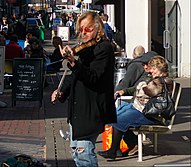
-

Street performer using a burn devilstick in São Paulo, Brazil
See also [edit]
- Busking Day
- Category:Busking venues
- Listing of circus skills
- List of busking locations
- Music Under New York
- Skomorokh
- Street artist
- Street painting
- Street theatre
References [edit]
- ^ "Busker" Merriam-Webster Lexicon. Quote: "importantly British"
- ^ "Busker" Cambridge Dictionary. Quote: "mainly Britain"
- ^ "busker" Archived 27 September 2007 at the Wayback Machine Definition from the Merriam-Webster Online Lexicon
- ^ "buscar", Diccionario de la Lengua Española (in Spanish) (23rd ed.), Real Academia Española
- ^ a b Baird, Stephen (2000)."The History and Cultural Touch on of Street Performing in America: Ben Franklin". Street Performers and Buskers Advocates. Retrieved 2010-06-10.
- ^ "mariachi" Definition from the Merriam-Webster Online Dictionary
- ^ Ferris, Jedd (25 September 2008). "Catching Upwardly With ... Onetime Crow Medicine Show". Paste . Retrieved 28 September 2012.
- ^ International Quango for Traditional Music, Study from the International Coming together of the International Council for Traditional Music's Study Group on Folk Musical Instruments, Volume 11, Musikmuseet, 1992, p. 54
- ^ Eva Bonitatibus. "L'arpa perduta - 50'identità dei musicanti girovaghi" (PDF) (in Italian and English). consiglio.basilicata.it. Retrieved 22 June 2016.
- ^ Somerville, Chris (1997) Who is Mr Punch punchandjudy.com. Chris Somerville. Retrieved 2010-06-xiv.
- ^ Tanenbaum, Susie, J. (1995). Underground Harmonies: Music and Politics in the Subways of New York. Google books; Cornell University Press. ISBN 0-8014-8222-iv
- ^ Startz, Dick (25 May 2005). "What this town needs is a piddling street music". uwnews.org. Academy of Washington News and Information. Archived from the original on 4 April 2008.
- ^ MTA: Arts for Transit: Music Under New York. mta.info; Metropolitan Transportation Authority, New York. Retrieved 2016-07-15.
- ^ (Cohen and Greenwood 1981: fourteen) Smith, Murray (1996). Traditions, Stereotypes, and Tactics:: A History of Musical Buskers in Toronto. cjtm.icaap.org; Canadian Journal for Traditional Music. Retrieved 2010-06-10.
- ^ Blue, Niceol (27 June 2006). A History of Busking Archived 15 June 2006 at the Wayback Machine Pike Market place Performer'due south Guild. Retrieved 2010-06-11.
- ^ (Krickeberg 1983 : 24). Smith, Murray (1996). Traditions, Stereotypes, and Tactics:: A History of Musical Buskers in Toronto. cjtm.icaap.org; Canadian Journal for Traditional Music. Retrieved 2010-06-x.
- ^ (Krickeberg 1983 : 62. Smith, Murray (1996). Traditions, Stereotypes, and Tactics:: A History of Musical Buskers in Toronto. cjtm.icaap.org; Canadian Periodical for Traditional Music. Retrieved 2010-06-10.
- ^ Berger v. Seattle, C03-3238JLR (PDF). Conclusion, U.South. Commune Courtroom, Western District of WA at Seattle, 22 Apr 2004. Retrieved 2010-06-11.
- ^ Why, Who (July 2014). "Who, what, why: Where is the hardest place in the U.k. to be a busker?". BBC News . Retrieved 9 October 2014.
- ^ "Street Performances in New York". 411newyork.org. 16 July 2007. Retrieved 19 July 2012.
- ^ Appleton, Natalie (7 Feb 2010). "The Large Busk: London Busking Explained". The London Insider. Archived from the original on 13 February 2010. Retrieved xv June 2010.
- ^ The Ultimate Cigar Aficionado: Ninety-eight-yr-old George Burns Shares Memories of His Life Archived seven March 2010 at the Wayback Auto , article and interview by Cigar Aficionado Online
- ^ Murray, Oliver (ane Baronial 2014). "Video surfaces of band's humble beginnings". Daily Telegraph . Retrieved 26 August 2020.
- ^ "Living Portrait serial: The Spoon Lady". Citizen Times . Retrieved 25 January 2017.
- ^ weingarten, Gene (April 8, 2008) "Pearls Before Breakfast: Can one of the nation'southward keen musicians cut through the fog of a D.C. rush hour? Let'due south notice out" The Washington Post
- ^ "Catfish and the Bottleman reveal touching Aussie story behind their ring proper noun". abc.net.au . Retrieved 3 July 2015.
- ^ "Archived re-create". Archived from the original on 14 May 2011. Retrieved 26 November 2009.
{{cite web}}: CS1 maint: archived copy every bit title (link) - ^ "Classical grouping G4 denote divide". 6 Apr 2007. Retrieved 12 September 2016 – via bbc.co.uk.
- ^ metrowebukmetro (24 Feb 2008). "X Factor star tops classical charts". Retrieved 12 September 2016.
- ^ Alex Vadukul (16 July 2020). "It's a Tough Fourth dimension to Be a Street Musician With a 900-Pound Piano". The New York Times . Retrieved vi November 2021.
- ^ From Busker To Billionaire: How Guy Laliberté Achieved Success EvanCarmichael.com.
- ^ Modern Blues Harmonica (half dozen March 2007). "Satan and Adam – Harlem, 1987 (in U2'southward Rattle and Hum)". Archived from the original on 7 November 2021. Retrieved 12 September 2016 – via YouTube.
- ^ A Night At The Opera Archived 10 May 2015 at the Wayback Machine QueenZone.com Retrieved 23 January 2013
- ^ Hansen, Liane (22 September 2002). "The Subterranean World of Peter Mulvey". Weekend Edition. National Public Radio. Retrieved 13 June 2010.
- ^ "Natalia Paruz, musical saw Player". subwaymusicblog.com (Vimeo). fifteen March 2011. Retrieved 9 April 2011.
- ^ "After Years Hole-and-corner, a Subway Singer Gets the Spotlight" by Susan Hartman, The New York Times, 16 September 2016
- ^ Parton, Chris (nineteen July 2012). "Onetime Crow Medicine Show Carries Traditional State New Anthology, Carry Me Back, Takes a Somber Approach". CMT News . Retrieved 25 September 2012.
- ^ a b c Ewbank and Hildred, Rod Stewart: The New Biography, pp. 24–28.
- ^ Pareles, Jon; Romanowski, Patricia (1983). The Rolling Stone Encyclopedia of Rock & Curl . Rolling Stone Press/Top Books. p. 530. ISBN978-0-671-43457-ane.
- ^ Lucy Cormack (19 October 2016). "Tash Sultana review: Welcome to the jungle of the one woman ring". Sydney Morning time Herald . Retrieved 26 Jan 2017.
- ^ "A tearjerker from Wai" by Navami Naik, The Times of India, eleven February 2002
- ^ Hayley Westenra Biography Archived 27 January 2010 at the Wayback Machine askmen.com; IGN Entertainment.
External links [edit]
 | Look up busker in Wiktionary, the free dictionary. |
Organisations
- Earth Street Music – international project virtually street musicians
- Busker Central Calendar of worldwide busking events
- National Association of Street Artists Uk
- Street Arts
- Photographs of buskers around the world by Tudor ApMadoc
- The Busking Projection, celebrating and supporting buskers across the globe.
Press
- "Striving to make music nether the NYC streets". Daniel Strieff and Jon Sweeney. 24 August 2004. MSNBC.
- "What the ailing record manufacture can acquire from a successful subway musician". Nicholas Thompson. December 2003. Washington Monthly.
- "The Real Piano Human being" Steven Kurutz, thirty Baronial 2008. The New York Times.
Other
- McKay, George (2007). "'A soundtrack to the insurrection': street music, marching bands and popular protest". Parallax. 13 (i): 20–31. doi:ten.1080/13534640601094817. S2CID 143754205.
- Bennett, Elizabeth, and McKay, George. 2019. From Brass Bands to Buskers: Street Music in the UK. Norwich: AHRC/UEA. DOI: 10.13140/RG.two.ii.18521.98408
fleischmannexprion.blogspot.com
Source: https://en.wikipedia.org/wiki/Street_performance
0 Response to "The Art of Successful Busking for Fun and Profit"
Post a Comment