Line and Balance in Art Texture and Balance in Art
Balance is an important underlying aspect when it comes to visual compositions; our eyes tin can naturally spot when an artwork appears off-balance or harmoniously equanimous; balance signals to us a sense of wholeness. But there are different ways in which balance can be utilized to requite an artwork its character, we volition talk over this in more detail in this article forth with diverse balance in art examples.
Table of Contents
- i What Is Remainder in Art?
- 2 Types of Balance in Art
- ii.1 Symmetrical Balance
- 2.2 Asymmetrical Balance
- 2.3 Radial Balance
- two.4 Crystallographic Balance
- 3 Summary of Balance in Art
- four Principles of Art – Further Readings
- 5 Frequently Asked Questions
- 5.1 What Is Residue in Fine art?
- v.two What Are the Dissimilar Types of Rest?
- five.3 How Is Balance Created in Art?
- v.four What Are the Principles of Art?
What Is Balance in Art?
Balance is part of the principles of art, which are besides referred to every bit pattern principles; these are namely, emphasis, motion, rhythm, proportion, scale, harmony, unity, variety, and contrast. If y'all are not familiar with the principles of art, these act every bit guidelines or rules, so to say, that help in composing an artwork into an identifiable format.
Furthermore, an fine art composition consists of the various fine art elements, of which there are primarily seven. These are, namely, line, form, shape, color, value, space, and texture. All of these elements tin can be combined in thousands of ways according to the principles of art.
Let u.s.a. look closer at balance in art, which is commonly described equally the "visual weight" of an artwork. This can range from painting, sculpture, drawing, or graphic art. The "distribution" of the art elements is what determines the type of balance in an artwork.
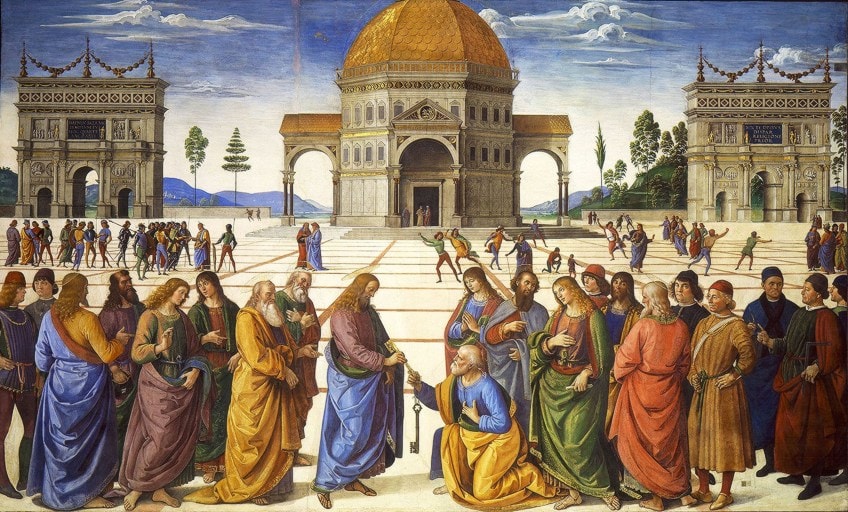 The Delivery of the Keys (1481-1482) by Pietro Perugino, Sistine Chapel, Rome;Pietro Perugino , Public domain, via Wikimedia Commons
Types of Rest in Fine art
There are unremarkably several types of techniques bachelor in each of the principles of fine art. These can be utilized in a myriad of ways to apply the principles more diversely. Therefore, when it comes to residue in art, while in that location are three primary types of techniques nosotros can use, some art sources mention four, and then we will discuss the four primary types of balance in art beneath.
Symmetrical Residuum
Symmetrical balance is also termed "formal remainder" in art, which means that there is an equal residuum between both halves of the visual limerick and the images are identical to each other. This type of residue in art besides includes a "mirroring" of halves, which is referred to as "Inverted symmetry". The composition'due south halves are separated past the mid-line or otherwise referred to as the "central axis". This can exist divided into horizontal, vertical, or diagonal sections.
Therefore, if the composition is separated horizontally, the top and bottom halves would mirror one another, and similarly, with vertical separation, the left and right halves would mirror 1 another.
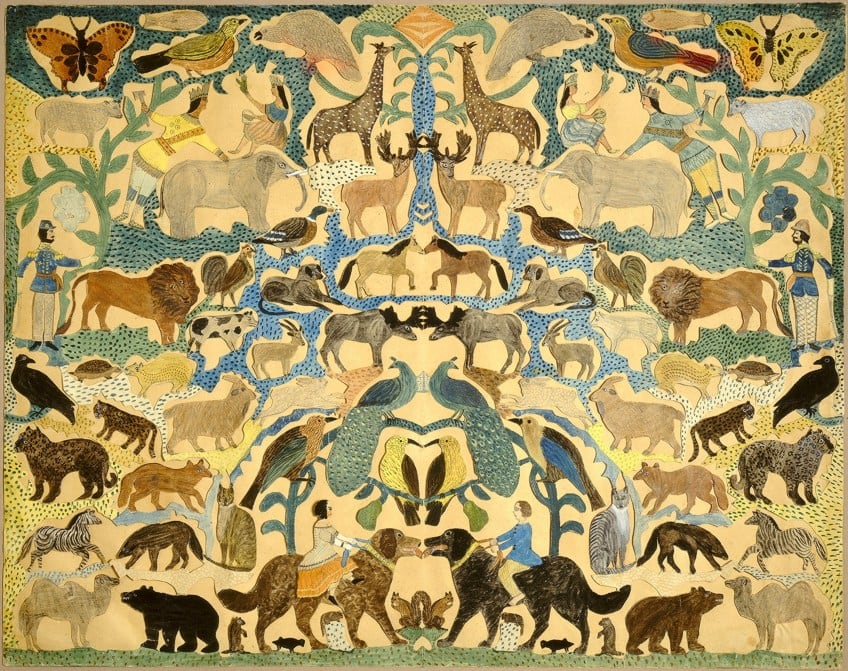 American Cutout of Animals (19th century) by an unknown creative person;National Gallery of Fine art, CC0, via Wikimedia Commons
Although symmetrical parts of an art composition are usually identical, these can also differ in slight variations, which is referred to as approximate symmetry. This is when the parts of both halves do non share the same identical or mirroring qualities, although the shapes or sizes may still be like.
Symmetrical balance in visual compositions is widely utilized in art of all modalities.
The common characteristics related to it include a sense of safety, harmony, order, rationality, and stability in artwork, however, it can go too boring or monotonous if overutilized. Nosotros will discover this technique commonly utilized in Academic art from the Renaissance period when the main genres for artworks too centered around History and Religious paintings. Symmetrical balance in art examples includes none other than the famous The Last Supper (1495-1498) by Leonardo da Vinci.
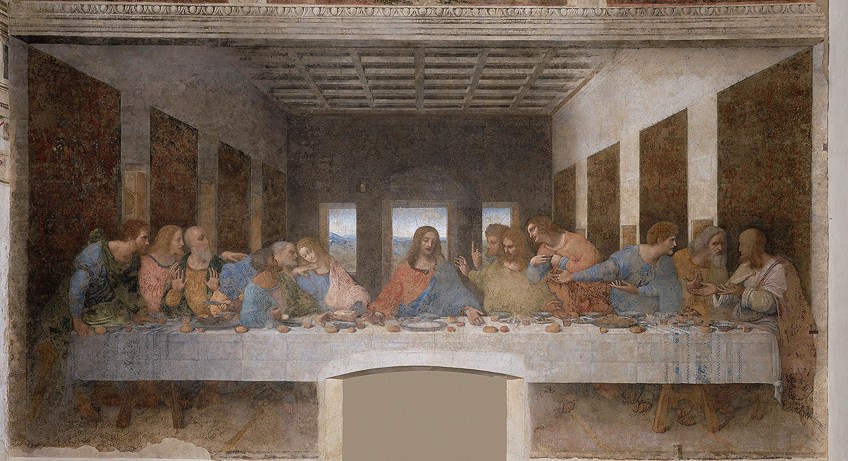 The Last Supper (1495-1498) by Leonardo da Vinci;Leonardo da Vinci, Public domain, via Wikimedia Commons
In this painting, gauge symmetry is utilized, while most of the composition is equal in how the fine art elements are placed, at that place are differences hither and there. For case, the Apostles sitting side by side to the central figure of Jesus Christ are all different, notwithstanding, the groundwork is rendered in like shapes on the left and right-hand sides.
Symmetrical residue does non only occur in paintings, but also in architecture like the Parthenon (432 BC) or the Taj Mahal (1632-1653). In both architectural examples, there is an equal placement of architectural structures, particularly the columns, which gives it an overall symmetry.
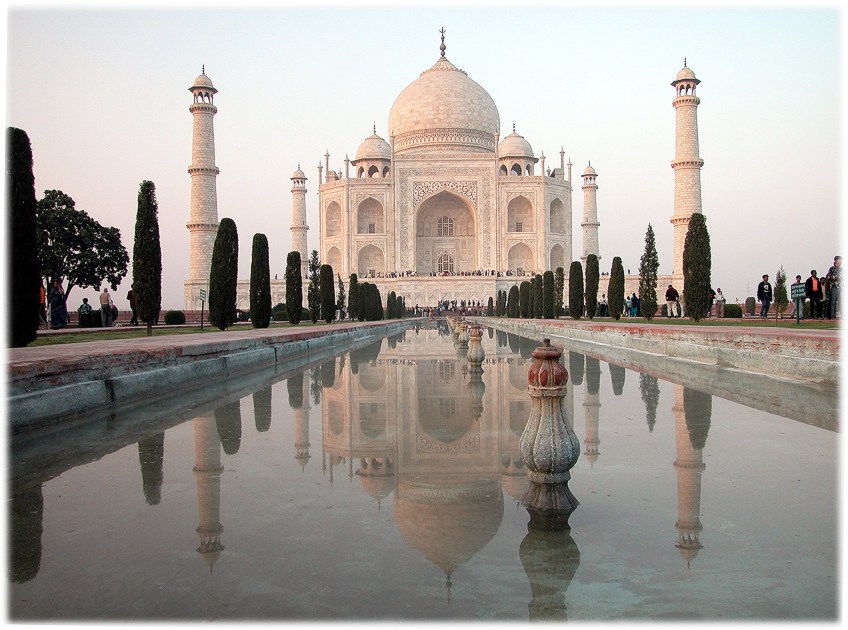 View of the south side of the Taj Mahal, Agra, India; Yves Picq http://veton.picq.fr, CC By-SA 3.0, via Wikimedia Commons
Symmetrical residuum tin also occur biaxially, which ways that the composition is balanced vertically and horizontally. The Op artist Victor Vasarely is famous for utilizing this type of symmetry in his artworks, for example, his Vega-Nor (1969), depicts the symmetrical residuum of a spherical object on a filigree.
Although the colors are different, these also mirror one another in the 4 quadrants.
In other examples like Frida Kahlo'due south Self-Portrait with Thorn Necklace and Hummingbird (1940), at that place is a feeling of balance because of the central figure of Kahlo and the 2 dark animals, the black monkey on the left and the blackness true cat on the right, on either side of her shoulders, giving equal weight to her left and correct side. Similarly, on her head is a effigy of viii bands with two butterflies on either side.
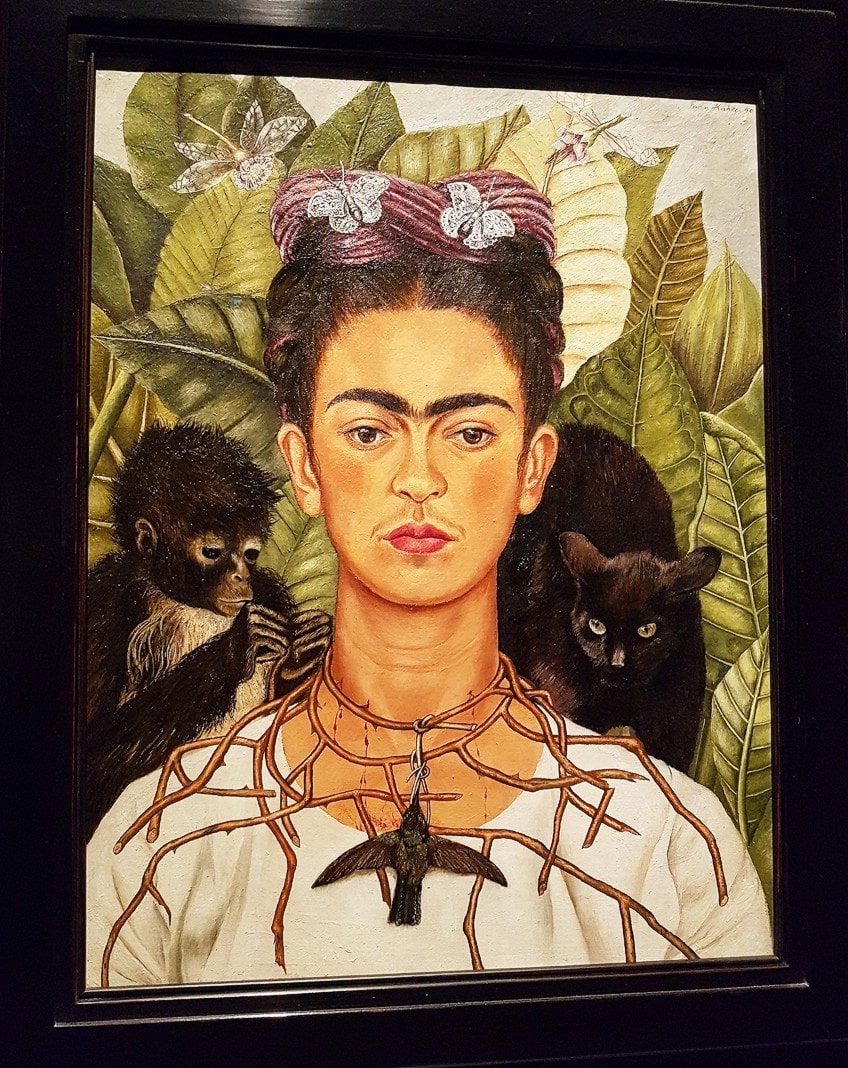 Cocky-Portrait with Thorn Necklace and Hummingbird (1940) past Frida Kahlo;Ambra75, CC BY-SA 4.0, via Wikimedia Commons
Maurits Cornelis Escher, otherwise known every bit M.C. Escher, created geometric abstract artwork, too referred to as tessellations, that announced perfectly balanced using repetition and patterned motifs. Examples include Day and Night (1938), Cartoon Hands (1948), and Lizard (1942), among many others.
Asymmetrical Remainder
Asymmetrical balance, too called "informal balance", on the other hand, refers to both halves of a composition retaining a sense of balance, merely with different art elements on each side. In other words, both sides have "visual weight" that complements one another to make it almost symmetrical.
The art elements arranged on each side of the limerick will range between unlike colors, forms, shapes, textures, or spaces; for instance, one one-half can announced black and the other half white, or one shape can be larger than the other shape or shorter and longer.
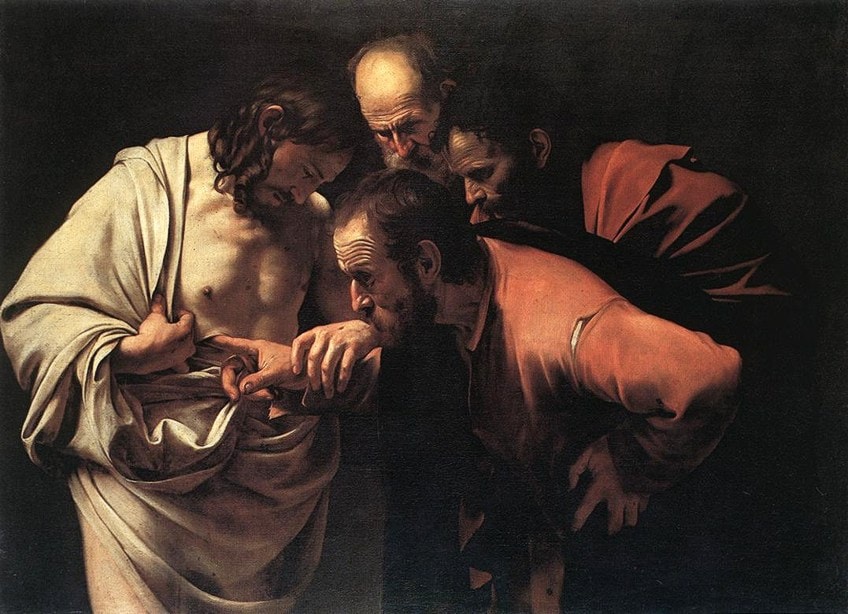 The Incredulity of Saint Thomas (1604) by Caravaggio; Caravaggio, Public domain, via Wikimedia Eatables
Asymmetrical residuum in art is also described as existence more "subjective" compared to symmetrical remainder considering it requires and involves closer planning to accomplish the visual weight on each side of the composition yet remain various.
Ironically, it can announced more relaxed and unplanned due to the variety in which the art elements have been placed.
Asymmetrical balance in art examples includes Vincent van Gogh'due south The Starry Night (1889), which depicts a tree filling the left-hand side and an emptier correct-paw side with only the moon and stars in the dark sky. The placement of these objects creates an overall counterbalanced outcome here, the one side is darker and heavier in shape than the other side'south lighter and smaller shapes, thus playing off one another.
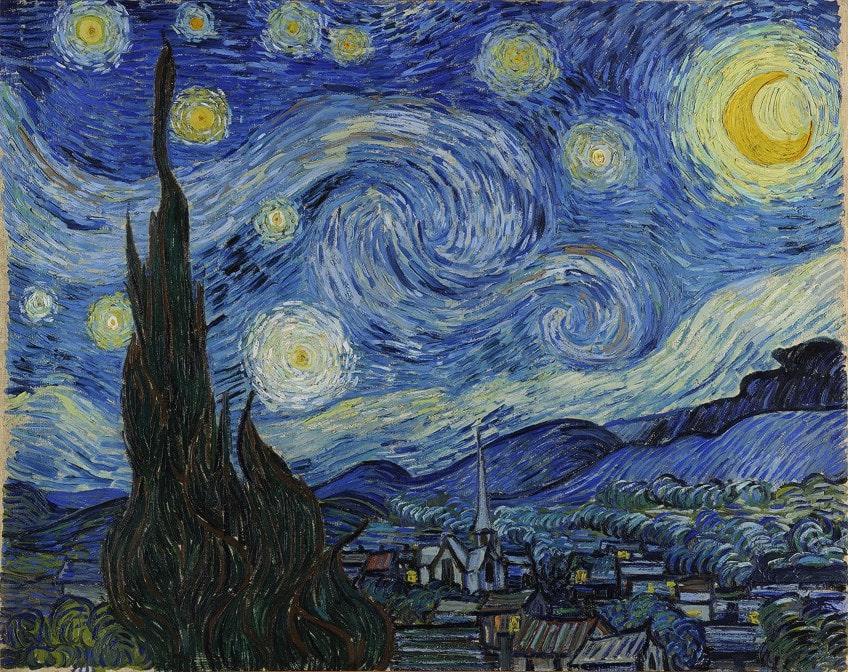 The Starry Night (1889) by Vincent van Gogh;Vincent van Gogh, Public domain, via Wikimedia Commons
The more bathetic works by Piet Mondrian from the De Stijl fine art movement depicts asymmetrical compositions that simultaneously create a sense of harmonious rest. Artworks include Limerick with Red, Yellowish, Blue, and Blackness (1921), in which Mondrian utilized diverse sizes of shapes, squares, rectangles, and black lines, coupled with areas of primary colors, white, and blackness.
 Composition with Carmine, Yellowish, Blue, and Blackness (1921) by Piet Mondrian; Piet Mondrian, Public domain, via Wikimedia Commons
Beyond painting, we as well run across asymmetrical balance in three-dimensional sculptures or objects, for example, Alexander Calder's Mobile (1942). Made from pigment and atomic number 26, the mobile consists of different sizes of biomorphic shapes. The correct side is heavier than the left side and creates stability for the residue of the structure, which thins out and becomes several round shapes dangling from thin wire.
The variations of size on both sides of the mobile emphasize its asymmetry, but information technology creates a harmonious whole, nevertheless.
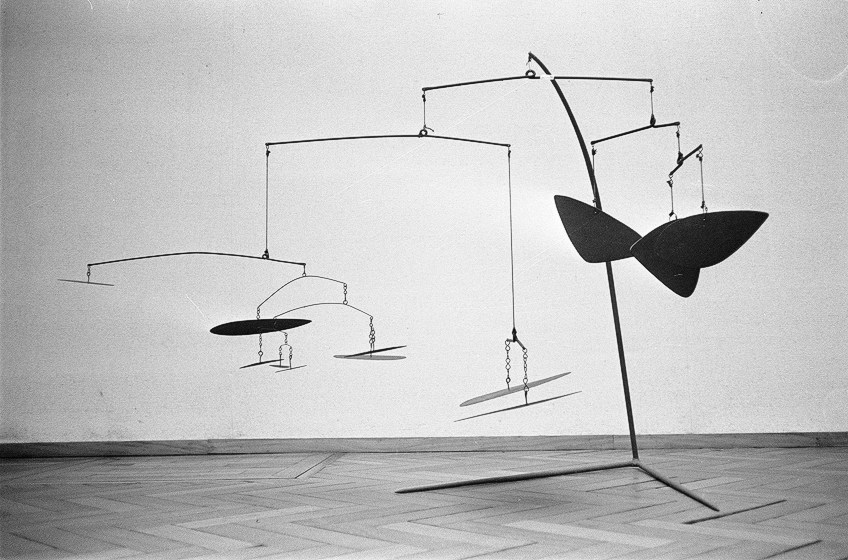 Alexander Calder's Mobile (1942) at the Stedelijk Museum Amsterdam, 1969;Eric Koch / Anefo, CC0, via Wikimedia Commons
Radial Balance
According to the dictionary, the term "radial" ways "developing uniformly around a central axis" or "relating to, placed like, or moving along a radius". A radius is a line from the heart of a round shape or grade, like a circle or sphere, to its outer edge or circumference. The discussion "radius" originates from Latin, and information technology means "ray" and "spoke".
Knowing where the term radial comes from will help us understand how radial balance in fine art is applied. Think of the rays of a light shining outwards or the spokes of a wheel extending to its outer edges.
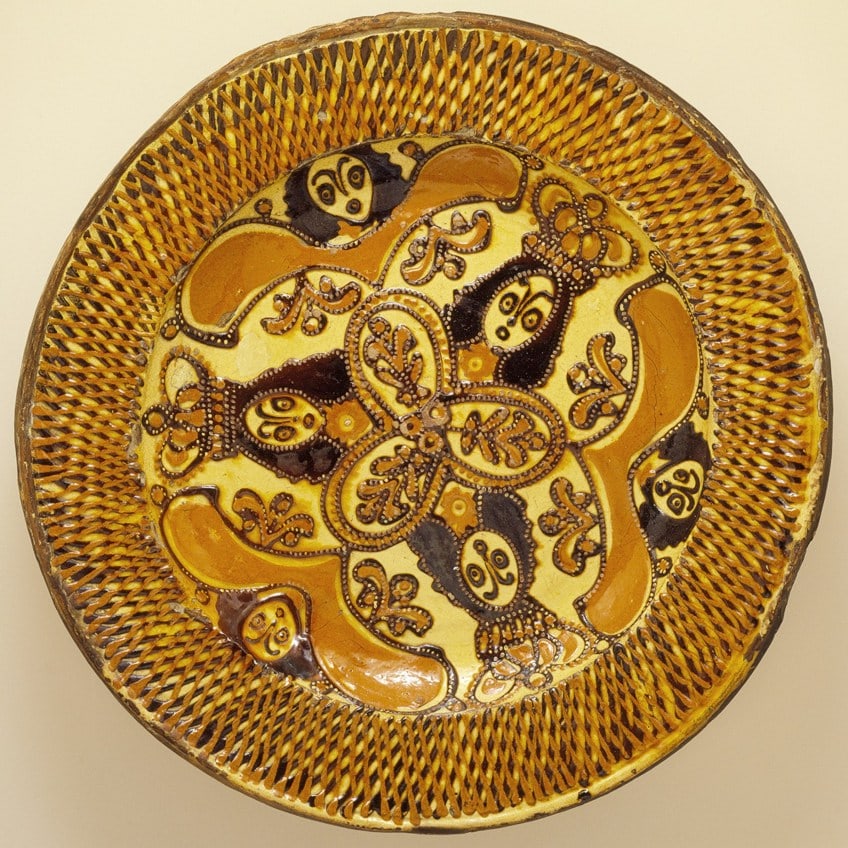 Charger of Charles II in the Boscobel Oak (c. 1685); Los Angeles Canton Museum of Art, Public domain, via Wikimedia Eatables
Radial symmetry in art involves whatever fine art element placed around the central betoken "radiating" outwards. Unremarkably, the art elements would be identical and repeated around this central point, these can range from lines, shapes, forms, colors, or others arranges in a radial pattern. This pattern is too recurrent in nature, for example, in flowers, stars, shells, starfish, and many more than.
Other examples include spirals utilized to engage the viewer and lead the gaze to the focal betoken.
Common radial balance in art examples includes mandalas, of which there are hundreds of different designs and patterns, as well as Rose Windows from many Gothic Cathedrals throughout Europe, for example, the Rheims Cathedral, Notre Dame, and Chartres Cathedral, all located in French republic amidst many others.
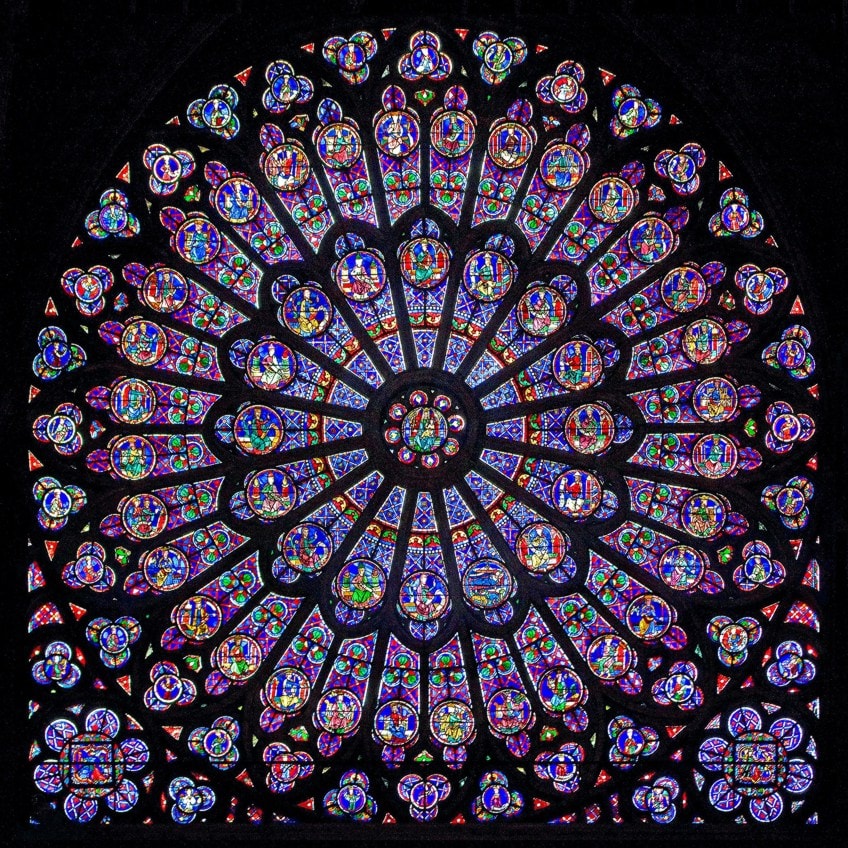 Rayonnant Gothic rose window (north transept) of the Notre-Dame de Paris Cathedral;Zachi Evenor based on File:N rose window of Notre-Dame de Paris, Aug 2010.jpg past Julie Anne Workman, CC Past-SA 2.0, via Wikimedia Commons
Crystallographic Balance
Crystallographic residuum, likewise termed "mosaic" or "all-over" residuum, refers to the more than randomized placements of art elements. In visual composition, these appear disordered and simultaneously create a sense of lodge or harmony; it is often referred to equally "organized chaos".
It is unremarkably recommended that the composition is more packed to appear fuller and thus more balanced as a event. The viewers' gaze volition be all over the composition and won't be able to locate a focal point.
Crystallographic balance in fine art examples includes the artworks of Abstract Expressionist Jackson Pollock. For example, his Number v or No. v, (1948) and Fall Rhythm: Number 30 (1950), amidst many others, all depict his characteristic action painting process of a variety of paints splattered and strewn across the canvas. When we observe Pollock'southward paintings, our gaze swims in the ocean of the entire expanse, which is filled to the brim, so to say, with lines and colors.
In that location is no apparent focal point and the seemingly chaotic nature of his compositions creates a balancing issue.
Summary of Residual in Art
| Types of Residual in Art | Characteristics | Artwork Examples |
| Symmetrical remainder | It is also referred to as formal remainder. When all parts of the composition are identical or complement i some other, both halves of the artwork mirror i another. There can be gauge and biaxial symmetry. | The Concluding Supper (1495-1498) by Leonardo da Vinci The Parthenon (432 BC) Taj Mahal (1632-1653) Vega-Nor (1969) by Victor Vasarely Self-Portrait with Thorn Necklace and Hummingbird (1940) by Frida Kahlo |
| Asymmetrical residual | It is likewise referred to as breezy balance. Different art elements are used on different sides/areas of the composition but still create a balancing effect. | Limerick with Large Red Aeroplane, Yellowish, Black, Grayness, and Blue (1921) by Piet Mondrian Mobile (1942) by Alexander Calder The Starry Nighttime (1889) by Vincent van Gogh |
| Radial balance | Refers mostly to circular shapes or forms where art elements are arranged from the central signal outwards, almost like rays of calorie-free. | Examples include Mandalas or Rose Windows |
| Crystallographic balance | This is likewise referred to every bit mosaic balance or all-over remainder. Art elements are more than disorganized and randomly arranged all over the visual limerick. | Number 5 (1948) and Autumn Rhythm: Number 30 by Jackson Pollock |
In this article, nosotros looked at rest in art, what it is and several of the different types that can be applied as techniques, namely, symmetrical, asymmetrical, radial, and crystallographic balance, which is also known equally mosaic balance; artwork examples explored how these techniques have been applied by artists from various art periods.
Principles of Art – Further Readings
- Principles of Art principal article
- Movement in Art
- Emphasis in Art
- Unity in Art
- Rhythm in Fine art
- Texture in Art
- Proportion in Art
- Harmony in Art
Rest is ane of the principles of art and it works together with the elements of art, which gives it a multitude of methods in which to employ it. Whether it is lines, shapes, forms, colors, spaces, or textures, residuum tin can give an artwork character, variety, and a harmonious feel. It can be gentle on our optics or take our gaze on a wild goose chase, so to say, either way, residue in fine art becomes an essential part of an artwork's unified whole.
Frequently Asked Questions
What Is Balance in Art?
Residuum is one of the principles of art that gives an art composition its then-called visual weight through the system of art elements, namely, line, class, shape, color, value, texture, and space. The manner these are placed in a composition tin can either make information technology announced more harmonious or off-balance.
What Are the Different Types of Balance?
There are four main types of balance in fine art, namely, symmetrical balance, which means all art elements are placed in such a way where both halves of the composition are identical to the other, sometimes also mirroring another; asymmetrical remainder refers to unlike elements of art on both halves of the composition, merely it withal creates a sense of residuum; radial balance relates to fine art elements around a circular shape or form, and lastly crystallographic, or mosaic, balance refers to art elements placed randomly or more disorganized, it is besides called all-over balance.
How Is Balance Created in Art?
Balance can be created in various means utilizing specific art elements, for example, through larger shapes or forms, especially squares or rectangles compared to circles, darker or bolder colors, thicker lines, more than texture, as well equally how to utilise the space like foreground or background placement or along the edges compared to the center of the limerick. All the art elements interact with one some other; therefore it is important to understand how these volition create the so-called visual weight in the artwork.
What Are the Principles of Art?
In that location are several principles of fine art, namely, balance, emphasis, move, rhythm, variety, unity, harmony, proportion, scale, and contrast. These are virtually like guiding principles in how to utilize and employ fine art elements like colour, texture, value, shape, form, line, and space.
fleischmannexprion.blogspot.com
Source: https://artincontext.org/balance-in-art/
0 Response to "Line and Balance in Art Texture and Balance in Art"
Post a Comment